
Navigating Measure ULA for LA Multifamily Sales

For apartment owners and investors across Los Angeles, the transaction environment has changed dramatically over the past few years. What used to be a fairly predictable closing cost structure now requires far more detailed underwriting and exit planning.
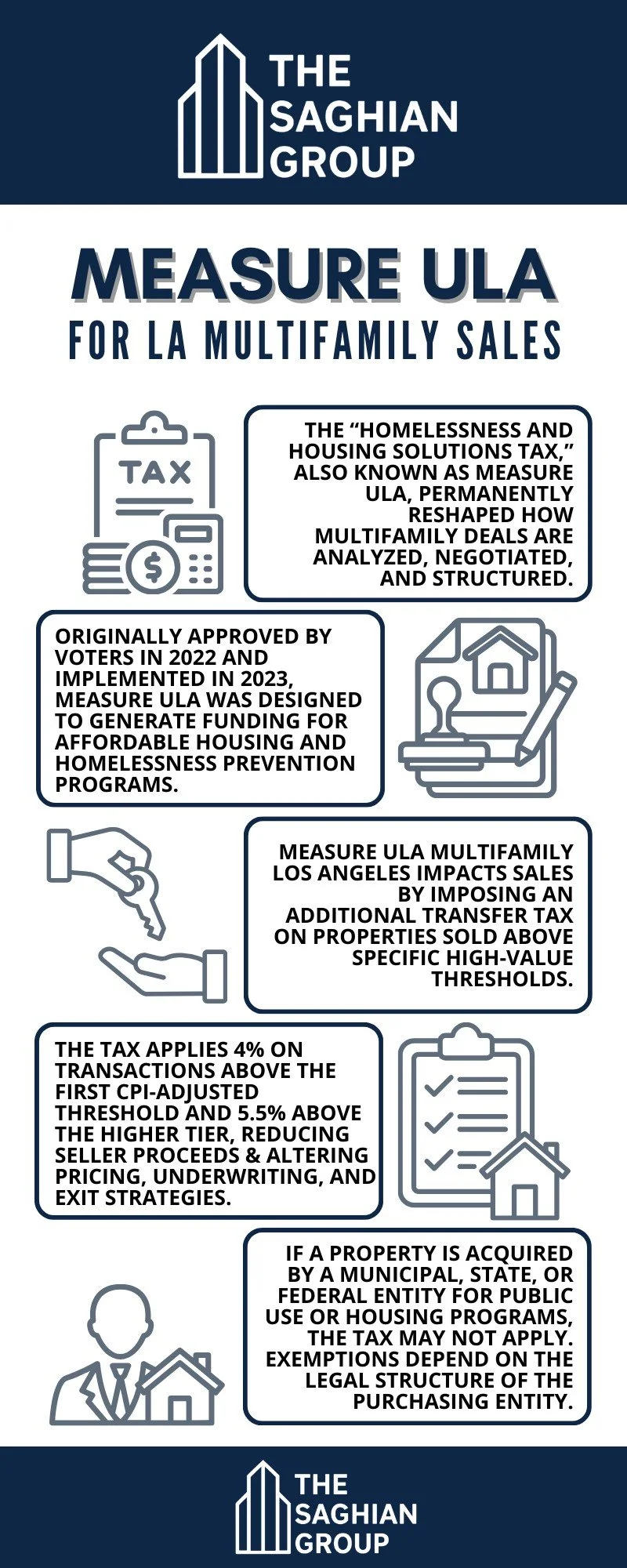
The introduction of the “Homelessness and Housing Solutions Tax,” better known as Measure ULA, permanently reshaped how multifamily deals are analyzed, negotiated, and structured.
Originally approved by voters in 2022 and implemented in 2023, Measure ULA was designed to generate funding for affordable housing and homelessness prevention programs.
While the policy goal is clear, the financial implications for apartment investors are substantial—especially for mid-size and large assets where transfer tax exposure can quickly reach six or even seven figures.
In today’s market, sellers are no longer just thinking about cap rates and buyer demand—they’re carefully modeling net proceeds after layered transfer taxes. Buyers, meanwhile, are factoring these costs into pricing expectations and return thresholds.
Understanding how thresholds adjust annually and how the tax is applied to gross value—not profit—is essential for anyone planning an acquisition or disposition in the next few years.
This guide breaks down the financial realities investors are facing in 2026 and highlights the practical strategies brokers and tax professionals are using to navigate transactions under the new structure, particularly for Measure ULA multifamily Los Angeles transactions and the broader impact on LA Mansion Tax apartment sales.

Photo by Pavel Danilyuk on Pexels | Source
How Does Measure ULA Impact Multifamily Los Angeles Sales
Measure ULA multifamily Los Angeles impacts sales by imposing an additional transfer tax on properties sold above specific high-value thresholds.
The tax applies 4% on transactions above the first CPI-adjusted threshold and 5.5% above the higher tier, significantly reducing seller proceeds and altering pricing, underwriting, and exit strategies.

Photo by Tierra Mallorca on Unsplash | Source
What Are the Los Angeles Transfer Tax Thresholds for 2026
CPI Adjustments
One of the most misunderstood aspects of Measure ULA is that the original thresholds—$5 million and $10 million—were never intended to remain static.
The law requires annual adjustments based on the Consumer Price Index (CPI). This means the trigger points gradually increase over time to account for inflation. By 2026, the effective thresholds are higher than the original 2023 baseline, though many investors still reference the original numbers out of habit.
For underwriting purposes, investors should always verify the current CPI-adjusted thresholds before listing or entering escrow. Even small inflation adjustments can materially change whether a property falls above or below a tax tier.
Gross Value Calculation
Another critical detail: Measure ULA applies to the gross sales price, not to profit or equity.
This distinction is particularly important for highly leveraged properties.
Sellers may assume the tax applies only to gains but in reality, the calculation is based entirely on the contract price.
For example, a $6 million property with $5 million in debt still triggers the full tax amount—even if the seller’s net proceeds are minimal. In certain cases, this can significantly compress or even eliminate expected equity at closing.

Photo by MART PRODUCTION on Pexels | Source
Are There Measure ULA Exemptions for Apartment Sales
While most transactions are subject to the tax, there are several limited exemptions worth understanding.
Affordable Housing Transactions
One of the primary Measure ULA exemptions applies to certain transactions involving qualified nonprofit organizations.
If a nonprofit buyer commits to maintaining or converting the property into affordable housing under approved guidelines, the transaction may qualify for exemption or reduction.
These structures are becoming increasingly common, particularly for older rent-controlled assets. However, the eligibility criteria are specific and require early coordination with legal and tax advisors.
Government Entities
Certain government agencies are also exempt from the Measure ULA transfer tax.
If a property is acquired by a municipal, state, or federal entity for public use or housing programs, the tax may not apply. Sellers should always evaluate the buyer profile carefully, as exemptions depend on the legal structure of the purchasing entity.

Photo by Alena Darmel on Pexels | Source
Can Commercial Real Estate Tax Planning Mitigate the Cost
While Measure ULA cannot simply be avoided, strategic planning can help minimize its impact.
Strategic Pricing Near Thresholds
One of the most noticeable market behaviors since implementation has been the emergence of what brokers call the pricing cliff.
If a property’s value is near a threshold, sellers may intentionally price slightly below the trigger point to avoid the tax altogether. Crossing the threshold by even a small margin can add hundreds of thousands in transfer costs.
For example, a property expected to trade at $5.2 million may instead list closer to the adjusted threshold to preserve seller proceeds and attract more buyer activity.
This strategy has created pricing clusters across the market.
Brokerage Advisory Checklist for Tax Planning
Before listing a multifamily asset, sellers should coordinate with both their broker and tax advisor. Key questions include:
Can any value legally be allocated to non-real estate components (furniture, business value, or equipment)?
How does the projected sales price compare to current CPI-adjusted thresholds?
What are the net proceeds after federal, state, and transfer taxes?
Does a 1031 exchange still meet financial goals after ULA costs?
Are there potential nonprofit or exempt buyers in the market?
Should pricing strategy aim below or above the threshold based on demand?
These conversations are becoming standard practice in commercial real estate tax planning.
Transfer Tax Cost Comparison Table
The financial difference between the standard city transfer tax and Measure ULA can be dramatic. The table below illustrates how quickly costs escalate once thresholds are triggered.
| Sale Price | Standard City Tax (0.45%) |
Measure ULA Tax (Est. 4% or 5.5%) |
Total Transfer Tax Bill |
|---|---|---|---|
| $4,000,000 | $18,000 | $0 (Exempt) | $18,000 |
| $6,000,000 | $27,000 | $240,000 (4%) | $267,000 |
| $12,000,000 | $54,000 | $660,000 (5.5%) | $714,000 |
For many investors, this cost shift alone has materially changed exit timelines and hold strategies.
Frequently Asked Questions
-
Yes. Measure ULA applies broadly to most property types—including multifamily, office, retail, and industrial—when sales exceed the CPI-adjusted thresholds.
-
Traditionally, transfer taxes are negotiated, but in most cases the seller pays the majority of the Measure ULA cost.
-
The thresholds are adjusted annually using CPI. Investors should confirm current figures before listing, as they change each year.
-
Generally, no. Artificially structuring transactions to avoid transfer taxes can trigger legal and tax complications.
-
No. Measure ULA applies to property transfers, not refinances.
-
A 1031 exchange can defer capital gains taxes but does not eliminate Measure ULA transfer taxes.
-
Transfer taxes may be treated as transaction costs affecting basis calculations, but investors should confirm with a qualified tax advisor.
Key Takeaway
The biggest adjustment investors must make in today’s market is underwriting discipline. Navigating measure ula multifamily Los Angeles transactions now requires modeling exit costs with far greater precision than in the past.
The additional 4% to 5.5% tax is large enough to materially affect internal rates of return, pricing strategy, and hold periods.
In 2026, successful sellers are those who plan early—verifying thresholds, evaluating exemptions, coordinating with tax professionals, and positioning assets strategically before going to market.
With careful Commercial real estate tax planning and a clear understanding of evolving transfer structures, investors can still achieve strong outcomes despite the new landscape surrounding LA Mansion Tax apartment sales.
If you're considering selling or acquiring a multifamily property and want to understand how Measure ULA affects your specific situation, a strategic conversation can make all the difference.
Reach out directly at (310) 401-1559 or email dsaghian@lyonstahl.com to review your property, model potential transfer costs, and build a clear path forward before entering the market.