
How to Increase Property Value with ADUs in LA
Photo by inboundREM
The housing landscape across Los Angeles has been evolving quickly over the past decade. As property prices continue to climb and housing inventory remains limited, homeowners are increasingly looking for ways to make their existing properties work harder.
One of the most effective strategies to emerge from this shift is building an accessory dwelling unit, commonly known as an ADU. Once viewed primarily as guest houses or “granny flats,” ADUs have transformed into powerful financial tools.
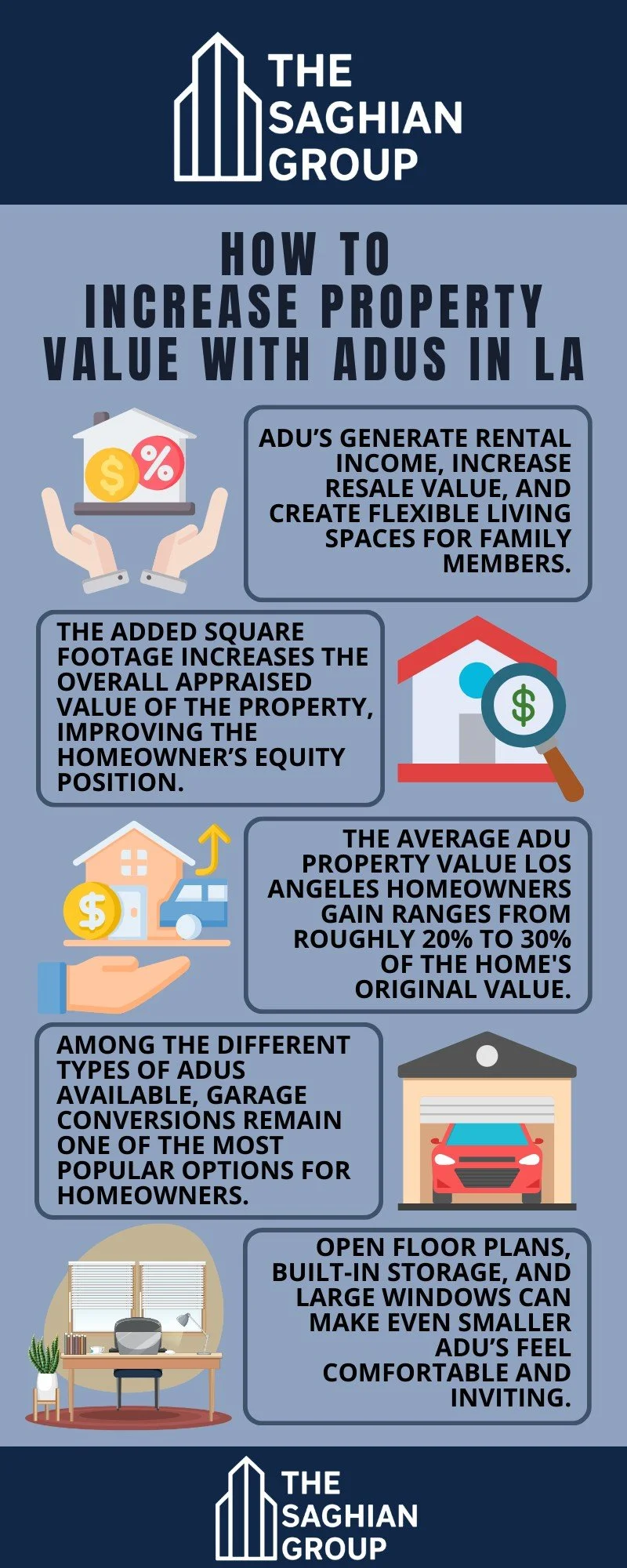
Today, homeowners are adding these secondary units to generate rental income, increase resale value, and create flexible living spaces for family members. With supportive state legislation and rising rental demand, building an ADU has become one of the most practical ways to expand both housing availability and personal wealth.
For property owners throughout the city, understanding how these additions affect ADU property value Los Angeles has become an important part of long-term investment planning.
Whether attached to the main house, built in the backyard, or converted from a garage, LA accessory dwelling units are proving to be one of the most reliable ways to increase property value while unlocking new income potential.

Photo by Artem Podrez on Pexels | Source
What Is the Average ADU Property Value in Los Angeles?
The average ADU property value Los Angeles homeowners gain ranges from roughly 20% to 30% of the home's original value.
Because LA accessory dwelling units add legally recognized livable square footage, they often raise appraisal values significantly, giving homeowners immediate equity while also creating long-term rental income opportunities.
Understanding California 2026 ADU Law Updates
State policy has played a major role in the growth of ADU construction throughout California.
Over the past several years, lawmakers have steadily removed barriers that once made building these units complicated or expensive. The California 2026 ADU law updates continue that trend by making the process faster and more accessible for homeowners.
Streamlined Permitting
One of the most impactful changes involves the permitting process. Historically, getting an ADU approved could take months due to local zoning restrictions, discretionary reviews, or unclear building standards.
Recent California 2026 ADU law updates require municipalities to process and approve compliant ADU applications more quickly.
Cities must follow strict timelines when reviewing plans, and they cannot impose design standards that effectively block development. As long as a project meets state guidelines and local building codes, approvals are significantly faster.
For homeowners, this streamlined process reduces holding costs. Fewer delays mean construction can start sooner, which ultimately accelerates both equity gains and rental income.

Photo by Alena Darmel on Pexels | Source
Owner-Occupancy Waivers
Another key update that has fueled investor interest is the continued waiver of owner-occupancy requirements for most ADUs.
Previously, homeowners often needed to live in either the primary residence or the ADU to qualify. With that rule relaxed in many cases, properties can now function more like small multi-unit investments.
This flexibility has made LA accessory dwelling units especially attractive for buyers seeking additional cash flow from single-family lots.
Maximizing LA Rental Income Potential
While increased home value is certainly appealing, the true power of ADUs often lies in their rental potential.
Cash Flow vs Equity
Building an ADU delivers two powerful financial advantages simultaneously. First, the added square footage increases the overall appraised value of the property, instantly improving the homeowner’s equity position.
However, the long-term return often comes from LA rental income potential. In many neighborhoods, a well-designed ADU can generate steady monthly income that helps offset mortgage payments, property taxes, and maintenance costs.
Over time, that rental revenue can significantly strengthen a property owner's financial position.

Photo by Mikhail Nilov on Pexels | Source
Targeting the Right Tenants
Design decisions also influence rental performance. Homeowners who thoughtfully plan their ADUs tend to attract higher-quality tenants and command stronger rents.
For example, compact but modern units with private entrances, in-unit laundry, and strong natural light are particularly appealing to young professionals. In areas such as Silver Lake and Echo Park, where traditional apartments can be expensive or limited, well-designed ADUs provide an attractive alternative.
Another growing tenant segment includes traveling nurses, remote workers, and professionals relocating temporarily to Los Angeles. These renters often prioritize privacy and convenience, making detached backyard units especially desirable.
Calculating Garage Conversion ROI Los Angeles
Among the different types of ADUs available, garage conversions remain one of the most popular options for homeowners.
The Most Affordable Option
A garage conversion often delivers the strongest garage conversion ROI Los Angeles homeowners can achieve.
Because the structure already exists, builders can reuse the foundation, framing, and roof. This dramatically lowers construction costs compared to building a new detached structure.
For many homeowners, the lower upfront investment combined with strong rental demand results in a faster payback period.
Photo by Ivan S on Pexels | Source
Design Considerations
However, converting a garage into livable space still requires careful planning. Plumbing lines must typically be added for kitchens and bathrooms, and insulation upgrades are necessary to meet California’s energy efficiency requirements.
The project must also comply with Title 24 energy standards, which regulate lighting efficiency, insulation levels, and ventilation. Proper layout planning is essential to prevent the unit from feeling cramped.
Smart design strategies—such as open floor plans, built-in storage, and large windows—can make even smaller ADUs feel comfortable and inviting.
ADU Type Comparison Table
Choosing the right ADU style depends on budget, property layout, and long-term goals. The following comparison provides a helpful overview for homeowners evaluating their options.
| ADU Type | Estimated Construction Cost | ROI Potential | Best Use Case |
|---|---|---|---|
| Garage Conversion | Moderate ($90k - $120k) | Very High | Maximizing existing structures |
| Detached ADU | High ($150k - $250k+) | High | Maximum privacy and rental yield |
| Attached ADU | Moderate to High | Good | Expanding the primary residence |
Each approach offers unique advantages. Garage conversions are often the most affordable entry point, while detached ADUs tend to command higher rents due to increased privacy.
Attached units fall somewhere in the middle, offering additional space while maintaining direct connection to the main house.
Key Takeaway
For homeowners looking to maximize their real estate investment, building an ADU has become one of the most practical and effective strategies available. These units increase overall property value, provide flexible housing options, and create long-term rental income opportunities.
By understanding the California 2026 ADU law updates, carefully planning design and construction, and evaluating potential garage conversion ROI Los Angeles, homeowners can make smart decisions that improve both equity and cash flow.
In today’s housing market, LA accessory dwelling units represent one of the most reliable ways to grow wealth through real estate while boosting ADU property value Los Angeles.
If you’re considering building an ADU and want to understand how it could impact your property’s value and long-term investment potential, professional guidance can make the process far smoother.
From evaluating zoning eligibility to estimating realistic rental income and resale value, having a knowledgeable advisor can help you make confident decisions.
To learn more about maximizing ADU property value Los Angeles or exploring the opportunities with LA accessory dwelling units, reach out to Daniel Saghian at (310) 401-1559 or email dsaghian@lyonstahl.com to discuss your property and your goals.
Frequently Asked Questions (FAQ)
-
Property taxes generally increase based on the assessed value of the newly constructed structure, not the entire property. The assessor evaluates the ADU’s construction cost and market value, then adds that amount to the property’s existing assessment.
-
In many situations, yes. State rules allow properties with a single-family home to build one ADU and one junior ADU, while multifamily properties may be eligible for additional units depending on lot size and existing structures.
-
Permit timelines vary depending on the project’s complexity, but many compliant applications receive approval within 60 to 90 days, thanks to streamlined review processes required under current state ADU laws.
-
Short-term rentals are regulated by the city’s Home-Sharing Ordinance. In most cases, the host must live on the property as their primary residence to legally operate a short-term rental.
-
Not necessarily. State laws have relaxed parking requirements in many areas, particularly when the property is near public transit. Garage conversions often no longer require replacement parking spaces.
-
California has introduced several financing options and assistance programs designed to help homeowners offset pre-development costs, including planning and permitting expenses. Availability can vary depending on funding cycles.
-
Separate utility meters are optional in many cases. Some homeowners prefer installing them for rental management purposes, but shared utilities are also common depending on the design and local utility regulations.