
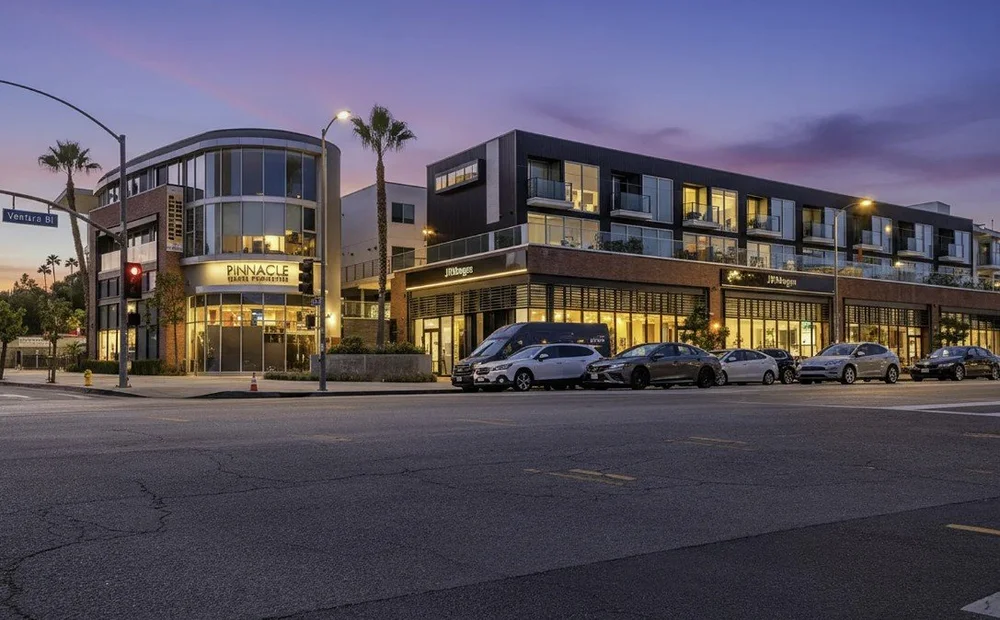
16300 Ventura Boulevard, Encino
Quick answer: When you sell an apartment building you have held for more than a year, the federal government taxes the profit at long-term capital gains rates of 0%, 15% or 20%. The part of the gain that comes from depreciation you took is taxed at up to 25%, and the 3.8% Net Investment Income Tax can apply on top. California taxes all capital gains as ordinary income, and escrow generally withholds 3⅓% of the sales price for the state unless an exemption applies. A 1031 exchange, an installment sale or holding until death can change the result. This guide explains the pieces so you can have a better conversation with your CPA. It is not tax advice.
Know your tax picture before you list, not after you sign. A building bought decades ago, with years of depreciation taken, can produce a large taxable gain even at an ordinary price for today's market. Here are the pieces that drive the bill, from federal and California sources, the options sellers use to manage it and the questions to bring to your CPA.
This article is general information, not tax or legal advice. Tax results depend on your facts. Work with a CPA or tax attorney before you sign a listing agreement or accept an offer.
How the Gain Is Calculated
Your taxable gain is roughly the sale price, minus selling costs, minus your adjusted basis. Adjusted basis generally starts with what you paid, adds capital improvements and subtracts the depreciation you took (or were allowed to take) over the years.
Here is a simple hypothetical with round numbers, for illustration only:
| Item | Amount |
|---|---|
| Sale price | $2,000,000 |
| Selling costs (commission, transfer taxes, escrow) | $100,000 |
| Original purchase price | $800,000 |
| Capital improvements | $150,000 |
| Depreciation taken | $500,000 |
| Adjusted basis ($800,000 + $150,000 − $500,000) | $450,000 |
| Total gain ($2,000,000 − $100,000 − $450,000) | $1,450,000 |
In this example, $500,000 of the gain traces back to depreciation and the remaining $950,000 is appreciation. Those two parts are taxed differently at the federal level, as explained below. Your CPA will compute the actual tax.
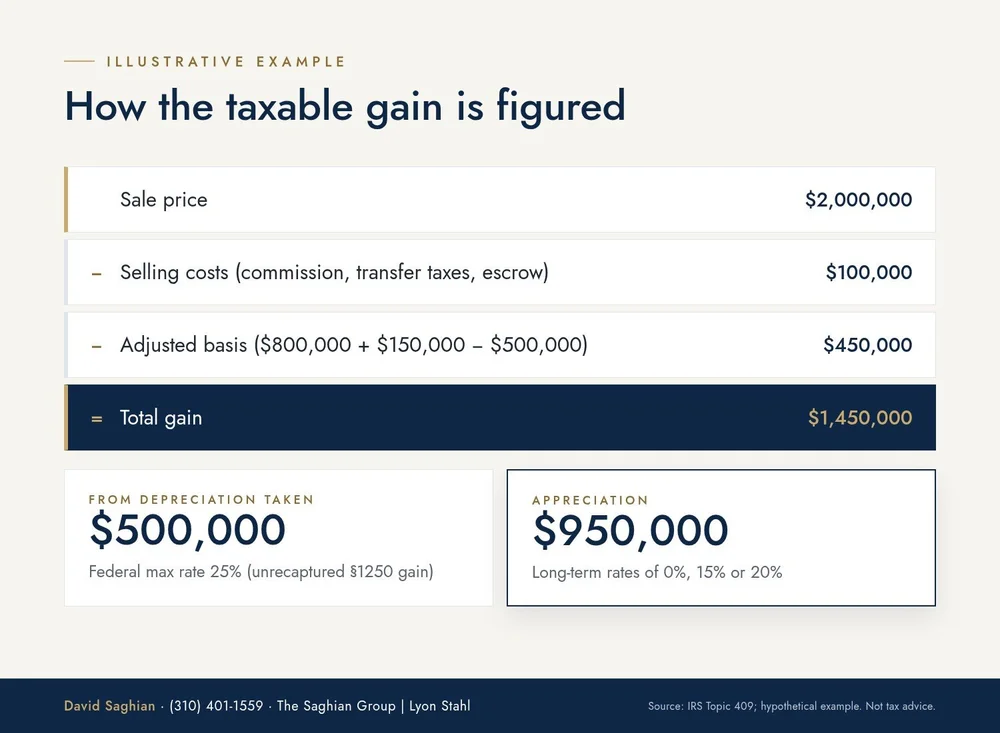
Hypothetical numbers. Your CPA will compute the actual tax.
Federal Tax: Capital Gains, Depreciation and the NIIT
According to IRS Topic 409:
- Long-term capital gains. Property held more than one year is taxed at 0%, 15% or 20%, depending on your taxable income.
- Unrecaptured Section 1250 gain. The part of the gain from depreciation on real property is taxed at a maximum rate of 25%.
- Short-term gains. Property held one year or less is taxed at ordinary income rates.
On top of that, the 3.8% Net Investment Income Tax can apply to gains from rental property when your modified adjusted gross income is above $250,000 for married couples filing jointly or $200,000 for single filers.
California Tax and Escrow Withholding
California treats capital gains differently. The Franchise Tax Board states that California does not have a lower rate for capital gains and that all capital gains are taxed as ordinary income.
California also collects some of the tax at closing. Under the FTB Form 593 instructions:
- Escrow generally withholds 3⅓% of the total sales price, or the seller can elect an alternative amount based on the gain (12.3% for individuals).
- Withholding is not required when the sales price is $100,000 or less, or when the seller certifies an exemption, for example for a qualifying 1031 exchange.
- If an exchange fails, the qualified intermediary withholds when it releases the funds.
Withholding is a prepayment, not a separate tax. It is credited when you file your California return. Ask your CPA which Form 593 choice fits your situation before escrow closes.
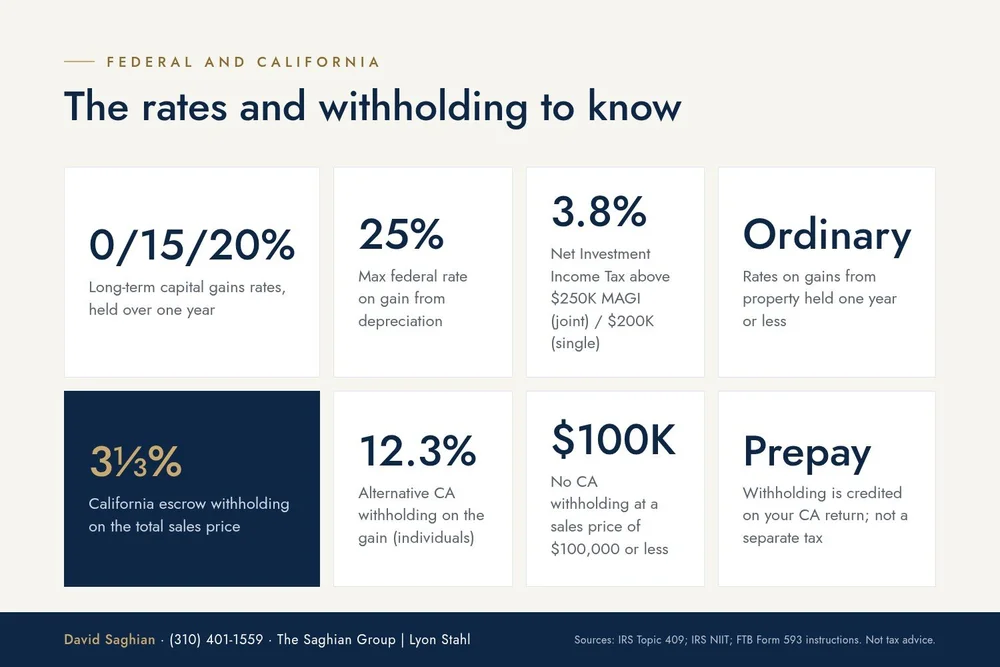
Ask your CPA which Form 593 choice fits your situation before escrow closes.
Transfer Taxes Are Separate From Income Tax
Transfer taxes are paid at closing based on the sale price, not your gain. Inside the City of Los Angeles that includes Measure ULA once the price crosses a threshold: for sales closing July 1, 2026 through June 30, 2027, 4% of the full price above $5,400,000 and 5.5% at $10,900,000 or more. A 1031 exchange defers income tax but does not avoid transfer taxes. See our Measure ULA guide for apartment sellers and our net proceeds guide.
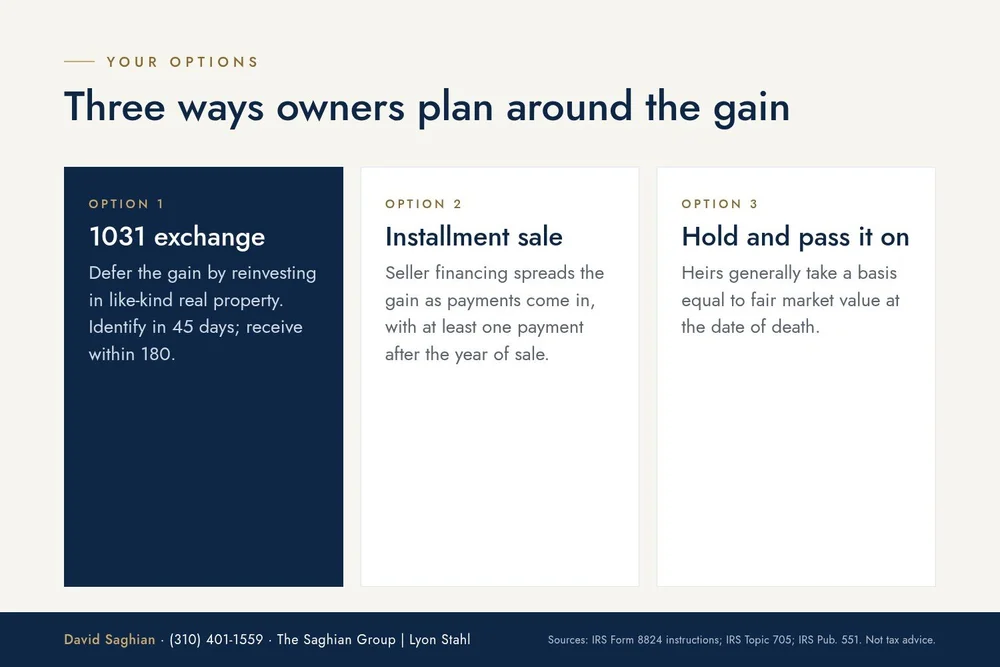
Option 1: A 1031 Exchange
A 1031 exchange lets you defer the gain by reinvesting the proceeds in like-kind real property held for business or investment. According to the IRS Form 8824 instructions, you have 45 days from the sale to identify replacement property and must receive it within 180 days (or by the due date of your return, with extensions, if earlier). The money is held by a qualified intermediary, not by you.
Our closings show a few versions of this:
- At 110 N Orlando Ave in Beverly Grove, a 4-unit building owned for 24 years, the seller is completing a 1031 exchange into a Delaware Statutory Trust (DST), a passive replacement with no day-to-day management. David Saghian represented the seller.
- At 1967 Preuss Rd in Beverlywood, the purchase was the buyer's replacement property (the "up leg") in a 1031 exchange. The buyer paid all cash and closed in 14 days.
To compare passive replacement options, see DST vs. NNN for a 1031 exchange. For the full process, see our 1031 exchange page.
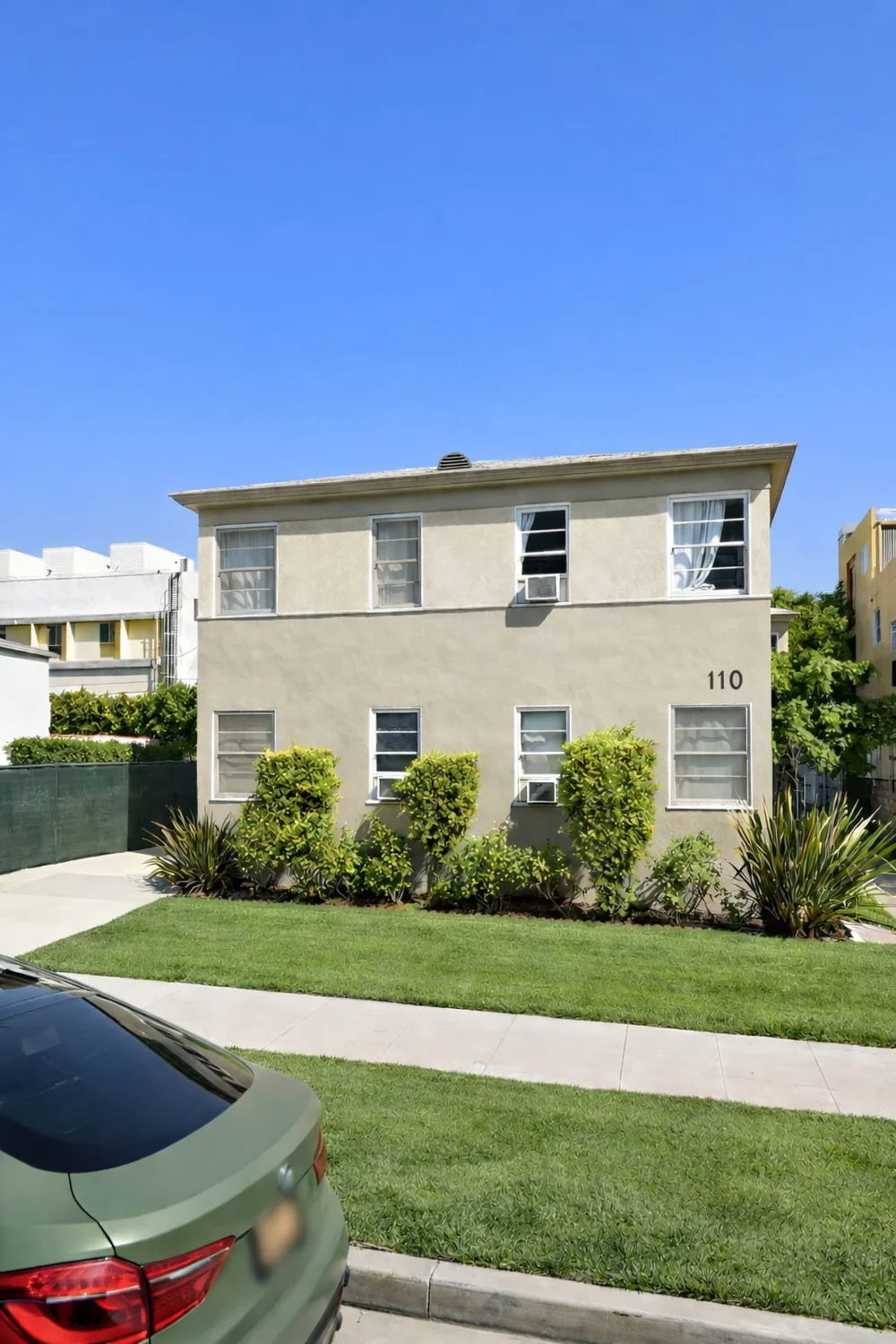
Front of 110 N Orlando Avenue, Beverly Grove
Option 2: An Installment Sale (Seller Financing)
If you carry back part of the price as a loan, you may be able to report the gain over time as you receive payments rather than all in the year of sale. IRS Topic 705 defines an installment sale as a sale where at least one payment is received after the tax year of the sale. California withholding on an installment sale generally applies to the down payment and then to the principal of each later payment.
At 9312 W Olympic Blvd in Beverly Hills, a 6-unit building sold off market, the parties negotiated a four-year seller carry-back. David Saghian represented both the buyer and the seller. Carrying a note means taking on the buyer's credit risk, so review the terms with your CPA and attorney.
Option 3: Holding, Inheritance and Basis
Under IRS Publication 551, the basis of inherited property is generally its fair market value on the date of death. That can greatly reduce the taxable gain when heirs sell soon after. This is one reason some owners choose to hold, and why some heirs sell soon after inheriting. See inherited apartment building: sell or keep? and our guides for probate sales and trustees.
Trust sales are common. 16300 Ventura Blvd in Encino, a mixed-use building with 49 apartments and two commercial units, was sold out of a trust. The Saghian Group represented both the buyer and the seller.
Review every option with your CPA and attorney before you list.
Timing Your Sale Around a Replacement Property
If you plan an exchange, the 45-day clock starts at closing, so line up replacement options before you list. Buyers using exchange money often move quickly. At 18218 Mansel Ave in Redondo Beach, a 1031 exchange buyer looking for stable, low-maintenance income closed in 21 days. David Saghian represented the buyer.
Timing across tax years can matter too. A sale that closes in January instead of December moves the gain into a different tax year. Ask your CPA whether that helps you.
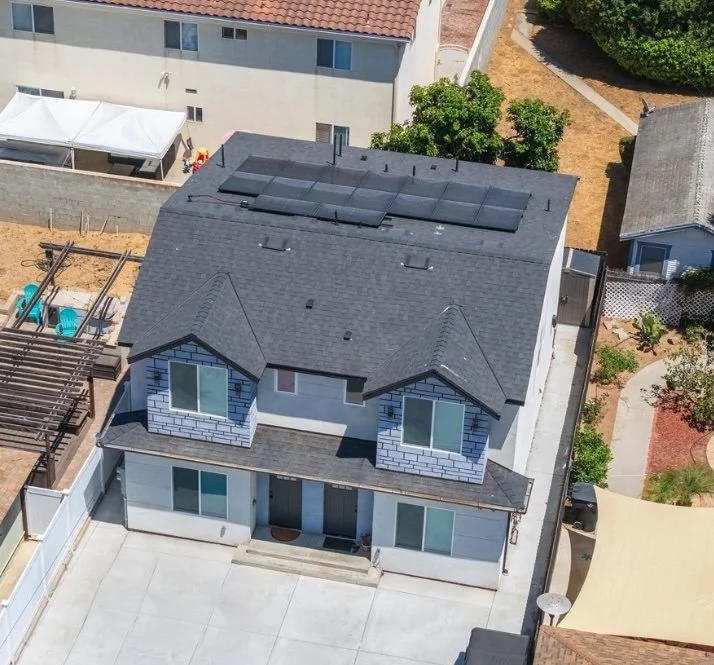
18218 Mansel Avenue, Redondo Beach
Questions to Ask Your CPA Before You List
- What is my adjusted basis, and how much depreciation have I taken?
- Roughly how much federal and California tax would a sale at this price create?
- Does the 3.8% NIIT apply to me?
- Should I consider a 1031 exchange, and what would I buy?
- Would seller financing help, and what are the risks?
- Which Form 593 withholding choice fits my situation?
- If the property is in a trust or estate, how does basis work for me?
Bring your purchase closing statement, a list of capital improvements, your depreciation schedules and recent tax returns.
Next Step: Price First, Then Plan the Tax
Start with a realistic price, then let your CPA turn it into an after-tax number. We can give you the first part: a price range based on closed sales and a net sheet that shows commissions, transfer taxes and payoff. For that, call David Saghian at (310) 401-1559 or request a free property valuation.
Frequently Asked Questions
What is the capital gains tax rate on selling an apartment building?
For property held more than one year, IRS Topic 409 lists federal long-term capital gains rates of 0%, 15% or 20%, depending on income. The part of the gain from depreciation is taxed at up to 25%, and the 3.8% Net Investment Income Tax may apply. Your CPA can tell you which rates apply to you.
Does California have a lower capital gains rate?
No. The Franchise Tax Board says California does not have a lower rate for capital gains and taxes all capital gains as ordinary income.
What is depreciation recapture on a rental property?
It refers to the part of your gain that comes from depreciation you took. For real property, IRS Topic 409 calls this unrecaptured Section 1250 gain and taxes it at a maximum rate of 25%.
How much does escrow withhold for California taxes?
Under the FTB Form 593 instructions, escrow generally withholds 3⅓% of the total sales price, or an alternative amount based on the gain, unless an exemption applies, such as a sale of $100,000 or less or a qualifying 1031 exchange. The withholding is credited on your California return.
Can a 1031 exchange avoid capital gains tax?
A 1031 exchange defers the gain when you reinvest in like-kind real property, following the 45-day identification and 180-day completion rules. It does not avoid transfer taxes such as Measure ULA.
Can I spread the tax out with seller financing?
An installment sale may let you report the gain as payments come in. IRS Topic 705 says an installment sale has at least one payment received after the tax year of the sale. Review the risks with your CPA and attorney.
Do heirs pay capital gains tax when they sell an inherited building?
IRS Publication 551 says the basis of inherited property is generally its fair market value on the date of death, which can reduce the taxable gain. Heirs should confirm the details with a CPA.
How do I reach David Saghian?
Call (310) 401-1559 or request a free property valuation on lamultifamilyadvisory.com. David Saghian is licensed with Lyon Stahl Investment Real Estate, DRE 01992252.