
Short answer: A cost segregation study splits an apartment building's cost into parts the IRS lets you write off faster than the usual 27.5 years, like appliances, carpet, cabinets, paving and landscaping. Under the 2025 tax law, those shorter-life parts of a building acquired after January 19, 2025 can generally be deducted 100% in the first year. In our hypothetical $5,000,000 example, the first-year federal deduction rises from about $109,000 to about $832,000. It's mostly a timing benefit: part of it is taxed back when you sell, and California doesn't allow bonus depreciation.
Updated: November 2026. Tax rules change, and we'll refresh this post when they do.
Here's how depreciation works on an apartment building, in plain English, with a worked example.
What is cost segregation?
The IRS treats a residential rental building as 27.5-year property, so you normally deduct its cost evenly over 27.5 years. Land is never depreciated. A cost segregation study pulls out the parts of the property with shorter tax lives, mainly 5-year items like appliances and carpet and 15-year land improvements like paving and fencing. Writing those off faster lowers taxable income in the early years of ownership.
What did the 2025 tax law change?
Two laws signed by President Trump set the rules. The 2017 Tax Cuts and Jobs Act allowed 100% "bonus" depreciation for property acquired after September 27, 2017, and for the first time let buyers claim it on used property, which covers most apartment purchases. It then phased down: 80% in 2023, 60% in 2024 and 40% in 2025.
The One Big Beautiful Bill Act (Public Law 119-21, signed July 4, 2025) made 100% bonus depreciation permanent for qualifying property acquired after January 19, 2025. The IRS issued interim guidance in Notice 2026-11 in January 2026.
Bonus depreciation only applies to property with a tax life of 20 years or less. The 27.5-year building itself doesn't qualify, which is why the study matters.
The acquisition date counts, not only the closing date. Under a written binding contract, the IRS generally treats the property as acquired on the latest of the contract date, the end of any cancellation period, or the date contingencies are met. Property already acquired on or before January 19, 2025 generally stays under the old phase-down (40% if placed in service in 2025). Have your CPA check your dates.
What parts of an apartment building can be depreciated faster?
A study typically sorts the purchase price into these groups:
- 5-year property: appliances such as refrigerators, ranges, dishwashers, washers and dryers; carpet and other removable flooring; cabinets and countertops; window blinds; decorative lighting; and the electrical and plumbing connections that serve that equipment.
- 7-year property: office furniture and equipment used to run the property, and items with no assigned class life. Apartment buildings usually have little of it.
- 15-year land improvements: parking lots and driveways, sidewalks, landscaping, fencing and gates, site lighting, outdoor drainage, and a pool if the building has one.
- 27.5-year building: the structure and its structural parts, including the roof, walls, windows, main plumbing and wiring, and central heating and air conditioning.
- Land: never depreciated.
One caution: you may hear about "qualified improvement property," a 15-year category for interior improvements. It applies to nonresidential buildings, so interior work on apartment units generally doesn't qualify. Those costs are sorted into the groups above instead.
How much could cost segregation save on a $5 million building?
This is a hypothetical example, not a real property or one of our sales. An investor buys a Los Angeles apartment building for $5,000,000 in 2026. We assume 40% of the price is land and that the study moves 25% of the building's cost into 5- and 15-year property. Published ranges for multifamily run from about 20% to 35% of the building's cost.
| Item | Without cost segregation | With cost segregation |
|---|---|---|
| Purchase price | $5,000,000 | $5,000,000 |
| Land (assumed 40%, not depreciable) | $2,000,000 | $2,000,000 |
| Building cost | $3,000,000 | $3,000,000 |
| Moved to 5- and 15-year property (25%) | $0 | $750,000 |
| Left as 27.5-year property | $3,000,000 | $2,250,000 |
| Year-one bonus depreciation (100%) | $0 | $750,000 |
| Year-one 27.5-year depreciation | $109,091 | $81,818 |
| Total year-one deduction | $109,091 | $831,818 |
| Federal tax value at an assumed 37% rate | $40,364 | $307,773 |
Here the study adds about $722,700 of first-year deductions, worth about $267,400 in federal tax at a 37% rate, if the investor can use the loss (see the passive-loss question below). The table uses a full year of building depreciation for simplicity; the real first year is prorated by month. Land is often a bigger share of value in Los Angeles, which shrinks what you can depreciate.
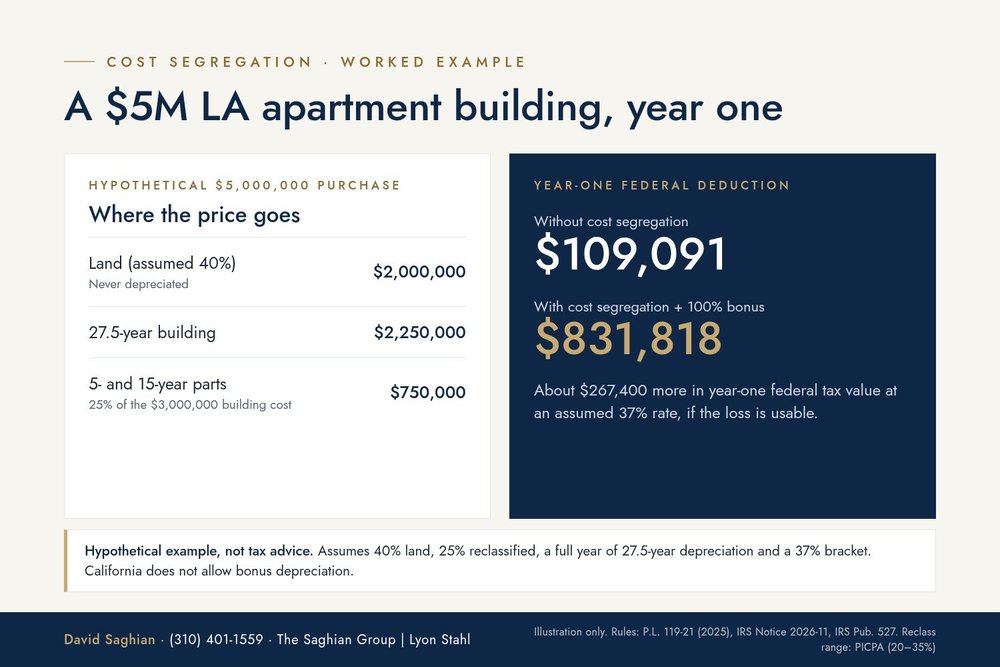
Hypothetical example only. The study moves deductions forward; it doesn't erase the tax.
The study doesn't erase tax. It moves deductions forward. The building has $750,000 less to depreciate in later years, and part of the benefit can be taxed when you sell.
How does a cost segregation study work, and what does it cost?
Cost segregation firms and CPA firms do the work, usually with engineers or construction cost estimators. The IRS's Cost Segregation Audit Techniques Guide says a detailed, engineering-based study is more reliable than a rule-of-thumb estimate. The provider reviews the closing documents and appraisal, tours the building and delivers a report your CPA uses to file. Published fees for apartment buildings commonly run from about $3,000 to $15,000 or more, depending on size. It's simplest to finish the study before you file the return for the year you buy.
I bought my building years ago. Is it too late?
Usually not. A "look-back" study can be done on a building you already own. Your CPA files Form 3115, an automatic change in accounting method, and takes the missed depreciation as a one-time catch-up deduction in the current year, without amending old returns. The bonus rate generally follows the year the parts were acquired and placed in service, so a building bought in 2024 would generally use that year's 60% rate, not today's 100%. If you've filed only one return for the building, your CPA may amend it instead.
What happens to the tax savings when I sell?
Depreciation lowers your tax basis, so some of the benefit comes back at sale. Gain from depreciation on the 5- and 7-year parts is Section 1245 recapture, taxed as ordinary income at rates up to 37%. Depreciation on the building itself is unrecaptured Section 1250 gain, taxed at up to 25%. Bonus taken on 15-year land improvements can also be taxed partly as ordinary income. Firms that do these studies often say the benefit outweighs the recapture if you hold for three to five years or more. See our post on capital gains tax when selling an apartment building.
Can I use the deduction against my other income?
Often not right away. Rental losses are generally passive, so a loss from bonus depreciation can offset other passive income but not wages or business income unless an exception applies. Owners who actively participate can deduct up to $25,000 of rental losses, but that allowance phases out between $100,000 and $150,000 of modified adjusted gross income. A qualifying real estate professional (more than 750 hours a year and more than half of your working time in real estate businesses, plus material participation in the rentals) can treat rental losses as nonpassive. Unused losses carry forward and are generally freed up when you sell in a fully taxable sale.
How does cost segregation work with a 1031 exchange?
The two can work together. Since the 2017 law, 1031 exchanges cover real property only, but IRS regulations treat most building parts a study labels 5- or 15-year as real property for 1031 purposes. Freestanding appliances and furniture are not. Two things to watch: Section 1245 recapture can be triggered if the replacement building has less 5- and 7-year property than the one you sold, and on a used replacement building, bonus depreciation generally applies only to the added basis (roughly, the new money), not the basis carried over. Plan the replacement property's study with your CPA and intermediary before you close. See our 1031 exchange page and DST vs NNN for a 1031 exchange.
Does California allow bonus depreciation?
No. California doesn't follow federal bonus depreciation (Revenue and Taxation Code Section 17250 says Section 168(k) doesn't apply), and the Franchise Tax Board says California generally doesn't conform to the 2025 law. On your California return, the reclassified parts are depreciated over their regular 5-, 7- or 15-year lives instead, and the difference is tracked on FTB Form 3885A. A study can still speed up California deductions, just less than federal ones.
Buying or selling an LA apartment building?
Call David Saghian at (310) 401-1559 or request a free property valuation. We don't give tax advice, but we can help you line up the timing and 1031 questions to bring to your CPA. See our track record.
This article is general information, not tax, legal or accounting advice. Tax rules change and depend on your facts, so consult a CPA or tax advisor before you buy, sell or file. The example is hypothetical and doesn't describe a real property or client.