
Short answer: Cash for keys is a voluntary deal: you pay a tenant to move out, and the tenant can say no. The Ellis Act lets an owner end tenancies without the tenants' consent, but only by taking every unit in the building off the rental market. In the City of Los Angeles, Ellis relocation for 2026-27 runs $11,000 to $27,400 per unit (more for some lower-income tenants if the building will be demolished), tenants get at least 120 days to move (a year for many seniors and disabled tenants), and restrictions are recorded against the property for years. A buyout keeps the building a rental. Ellis takes it out of the rental business.
Updated: November 2026. LAHD raises relocation amounts every July 1. The figures below are for July 1, 2026 through June 30, 2027.
This guide is for owners of rent-controlled (RSO) apartment buildings in the City of Los Angeles, with a section on what each path means for tenants. It's general information, not legal advice. Talk to a landlord-tenant attorney before you make an offer or file anything.
What is cash for keys?
Cash for keys is a voluntary buyout. The owner pays a tenant money, or offers something else of value such as free rent, to move out by an agreed date. The tenant doesn't have to accept and can stay if they say no. Owners use buyouts to deliver vacant units to a buyer, to renovate, or to bring an RSO unit's rent back to market. LAHD says rent on an RSO unit may be raised to market when a tenant accepts a buyout agreement or voluntarily moves out. The unit stays under the RSO for future increases.
What are LA's rules for a cash-for-keys buyout?
For RSO units, the city's Tenant Buyout Notification Program (LAMC 151.31) sets the steps:
- Disclosure first. Before making any buyout offer, written or spoken, give the tenant LAHD's RSO Disclosure Notice, signed and dated by you and the tenant. Offering money to vacate without it counts as tenant harassment under LAMC 151.33, except for offers made in a pending eviction case.
- A written agreement in the tenant's primary language, signed and dated by both sides, with this sentence in at least 12-point bold type above the tenant's signature: "You, (tenant name), may cancel this Buyout Agreement any time up to 30 days after all parties have signed this Agreement without any obligation or penalty."
- A 30-day right to cancel. The tenant can cancel for any reason within 30 days after both sides sign. If the notice or agreement doesn't follow the rules, the tenant can cancel for as long as the statute of limitations allows.
- File with LAHD within 60 days of signing. Submit the signed Disclosure Notice and the agreement through LAHD's online Tenant Buyout system.
- No pressure. Offers must follow the city's Tenant Anti-Harassment Ordinance: no threats, no holding back repairs, and no telling a tenant they have to move when they don't.
There's no legal minimum or maximum for a buyout. LAHD's own notice says the amount and the move-out date are negotiated. If the rules aren't followed, the tenant can sue for damages plus a $500 penalty, and the violation can be raised as a defense in an eviction case.
What is the Ellis Act, and how does it work in Los Angeles?
The Ellis Act (California Government Code Section 7060 and following) lets an owner go out of the residential rental business, even in a rent-controlled building. The catch is that you must withdraw every unit in the building, not just some. In Los Angeles, the RSO's Ellis rules are in LAMC 151.22 through 151.28, and the owner must act in good faith. Per LAHD, the main steps are:
- Record a memorandum of the Notice of Intent to Withdraw with the County Recorder, review the forms with an LAHD analyst, then file the Notice of Intent to Withdraw by first-class mail. The postmark is the file date. Notices ending each tenancy are served that same day, and the Notice to Tenant of Pending Withdrawal goes out within 5 days.
- Tenants get at least 120 days from the file date. A tenant who is 62 or older or disabled and has lived in the unit at least one year gets one year if they claim it in writing within 60 days. If the plan is demolition for new construction, the notice is six months, and tenants can stay until six months before construction starts.
- Pay relocation to each household within 15 days of serving the notice, directly or through an escrow account, and pay LAHD's per-unit fees.
- File an Annual Property Status Report with LAHD each year for seven years, or until LAHD says reporting is complete.
Newer buildings covered by LA's Just Cause Ordinance instead of the RSO also list removal from the rental market as a no-fault reason, with the same relocation amounts. Statewide, AB 1482 treats withdrawal from the rental market as a no-fault just cause. See our post on AB 1482 vs LA rent control.
How much relocation does an Ellis Act withdrawal cost in 2026?
LAHD sets relocation per unit, not per tenant. For July 1, 2026 through June 30, 2027:
| Household | Tenancy under 3 years | 3 years or more, or lower income |
|---|---|---|
| Eligible tenant | $11,000 | $14,400 |
| Qualified tenant (62 or older, disabled, or with a minor child) | $23,150 | $27,400 |
"Lower income" here means household income at or below 80% of area median income. If the building will be demolished for new construction, lower-income tenants are owed much more under the state Housing Crisis Act and the city's Resident Protections Ordinance. LAHD's 2026-27 amounts under that ordinance are $87,450 for low-income, $96,750 for very low-income and $115,480 for extremely low-income households. The owner pays the highest amount that applies, not both.
LAHD also charges a relocation service fee of $623 per unit for eligible tenants or $1,002 for qualified tenants, plus an $86 administrative fee per unit. In a hypothetical 10-unit building where every household is an eligible tenant of 3 years or more and nothing is demolished, the relocation alone is $144,000, plus about $7,090 in LAHD fees, before legal costs.
What restrictions stay with the property after an Ellis withdrawal?
Ellis lets you leave the rental business, but the state and city make it costly to come back. The main limits:
- Re-renting within 2 years: displaced tenants can sue for actual and exemplary damages, the city can seek exemplary damages, and displaced tenants who asked in writing must get the first offer.
- Re-renting within 5 years: units must be offered at the lawful rent in effect when the Notice of Intent to Withdraw was filed, plus allowed RSO increases.
- Re-renting within 10 years: a displaced tenant who asks in writing within 30 days of the owner's notice to LAHD gets the first offer. Skipping that offer can cost up to six months' rent in punitive damages.
- Notice before re-renting: file a Notice of Intention to Re-Rent with LAHD, then wait 30 days before renting to anyone other than a displaced tenant.
- New construction within 5 years: if the building is torn down and new rental units are offered within five years of withdrawal, the owner sets the first rents, but the new units fall under the RSO. An owner can apply for an exemption by including replacement affordable units, one-for-one or 20% of the new units, whichever is greater.
- Recorded on title: LAHD records these limits with the County Recorder, so they bind the next owner.
- State replacement rules for 10 years: under the Housing Crisis Act, units withdrawn under the Ellis Act in the past 10 years are "protected units" that a new housing project must replace.
Can I use cash for keys during an Ellis Act withdrawal?
Yes, and many owners do. Some tenants will leave sooner, or on a set date, for more than the required relocation. A negotiated deal can buy certainty on timing, especially when a senior or disabled tenant would otherwise be entitled to a full year. A few cautions:
- Treat the required relocation as the floor. A tenant who has been served an Ellis notice is already owed LAHD relocation and can simply wait out the notice period. An offer below that amount gives them little reason to sign, and an agreement that tries to sidestep required relocation invites a challenge.
- Follow the buyout rules too. Give the Disclosure Notice before any offer, use the required cancellation language and file with LAHD. Ask your attorney how the buyout program and your Ellis filing fit together.
- A buyout doesn't erase Ellis or state rules. The withdrawal still covers every unit, and the recorded limits still apply. If you plan to demolish, units that were rent-controlled or rented to lower-income households in the past five years still count as protected units that must be replaced. LAHD's buyout notice adds that lower-income tenants displaced for a demolition project should get relocation consistent with state law even under a buyout.
- Keep the paper trail: the signed notice and agreement, proof of payment, the move-out date and LAHD's filing confirmation. Buyers and their lenders will ask for it.
What do cash for keys and the Ellis Act mean for tenants?
Tenants have real choices in a buyout and firm rights in an Ellis withdrawal.
- In a buyout, you can say no and stay. You can talk to an attorney or call LAHD at (866) 557-7368 first, negotiate the amount and the move date, and cancel within 30 days after signing. The amount is whatever you agree to. There's no set minimum.
- In an Ellis withdrawal, you can't refuse, but you're owed relocation within 15 days of the notice ($11,000 to $27,400 per unit for 2026-27, more for lower-income tenants if the building will be demolished). You get at least 120 days to move, or one year if you're 62 or older or disabled, have lived there a year and claim it in writing within 60 days.
- Right to return: tell the owner in writing within 30 days of moving out that you'd consider an offer to come back (LAHD Form E4). If the units return to the rental market within 10 years, you may get the first offer, at your old rent plus allowed increases if it's within five years.
- If the building is demolished, lower-income tenants may have a right of first refusal to a comparable affordable unit in the new building, and displaced tenants can return at their prior rent if the demolition doesn't go forward and the units return to the rental market.
- Know what you're signing. How a buyout affects Ellis return rights can depend on timing and wording. Read it closely and get advice before you sign. Stay Housed LA (1-888-694-0040) offers free help to LA tenants.
How do cash for keys and the Ellis Act compare?
| Cash for keys | Ellis Act | |
|---|---|---|
| Tenant consent | Required; the tenant can say no | Not required |
| Units covered | Only units where you reach a deal | Every unit in the building |
| Cost | Negotiated, with no set minimum | LAHD relocation per unit ($11,000 to $27,400 for 2026-27), more for lower-income tenants if demolishing, plus fees |
| Timing | As agreed, with a 30-day right to cancel | 120 days, or one year for qualifying seniors and disabled tenants (six months if demolishing) |
| Building afterward | Stays a rental, and a vacated RSO unit can generally re-rent at market | Off the rental market, with re-renting restricted for up to 10 years |
| Recorded limits | None from the buyout itself | Yes, and they bind future owners |
| Main legal risk | Harassment claims or a cancelled agreement if the rules aren't followed | Bad-faith or re-rental claims, damages and penalties |
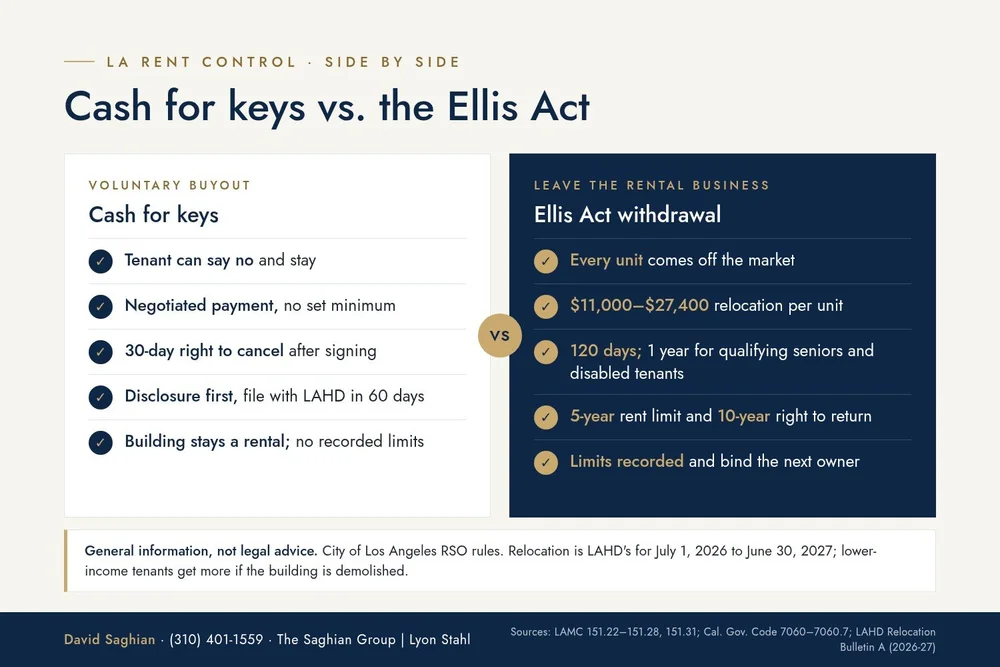
Relocation amounts are LAHD's for July 1, 2026 through June 30, 2027. General information, not legal advice.
Cash for keys usually fits when you want to keep the building as a rental, need only some units vacant, or are preparing a sale where vacant units add value. Ellis usually fits when you plan to leave the rental business for good, for example to demolish and build new or to convert to condos with separate city approvals, and can accept the limits that follow. Many owners combine the two.
How do buyouts and the Ellis Act affect a sale or redevelopment?
Buyers price what they can do with the building. In an RSO building, a vacant unit can be re-rented at market, so a buyer may pay more for it than for the same unit occupied at a below-market rent. A fully vacant building can also appeal to developers and owner-users. Our sale of 1442-1446 S Bedford St, a 29-unit Pico-Robertson development site, was delivered with all units vacant, so the buyer had no tenant relocations or buyouts to handle.
An Ellis withdrawal narrows the buyer pool. The recorded limits on re-renting, RSO coverage of new rental units built within five years and the state's 10-year replacement rule all pass to the buyer. That suits a developer or a user more than an investor who wants rental income. Under the Housing Crisis Act (SB 330, as amended), a project that demolishes protected units must replace them, pay lower-income tenants relocation, offer them a right of first refusal and let tenants stay until six months before construction. Protected units include units that were rent-controlled or rented by lower-income households in the past five years, so a buyout doesn't take a unit off that list.
Before you buy out tenants or file an Ellis notice ahead of a sale, get values for the building occupied, partly vacant and fully vacant. Sometimes the occupied price is close enough that the cost, delay and risk aren't worth it. See our posts on selling a rent-controlled building, apartment building comps and net proceeds.
Thinking about selling an RSO building with tenants?
Call David Saghian at (310) 401-1559 or request a free property valuation. We'll show you how buyers would price your building occupied and vacant, so you and your attorney can decide whether a buyout or an Ellis withdrawal makes sense. See our track record.
This article is general information, not legal or tax advice. Rent control, Ellis Act and buyout rules are detailed, change often and depend on your building and tenants. Talk to a landlord-tenant attorney before you offer a buyout, serve a notice or file with LAHD, and to a CPA about taxes. Relocation amounts are LAHD's for July 1, 2026 through June 30, 2027.