
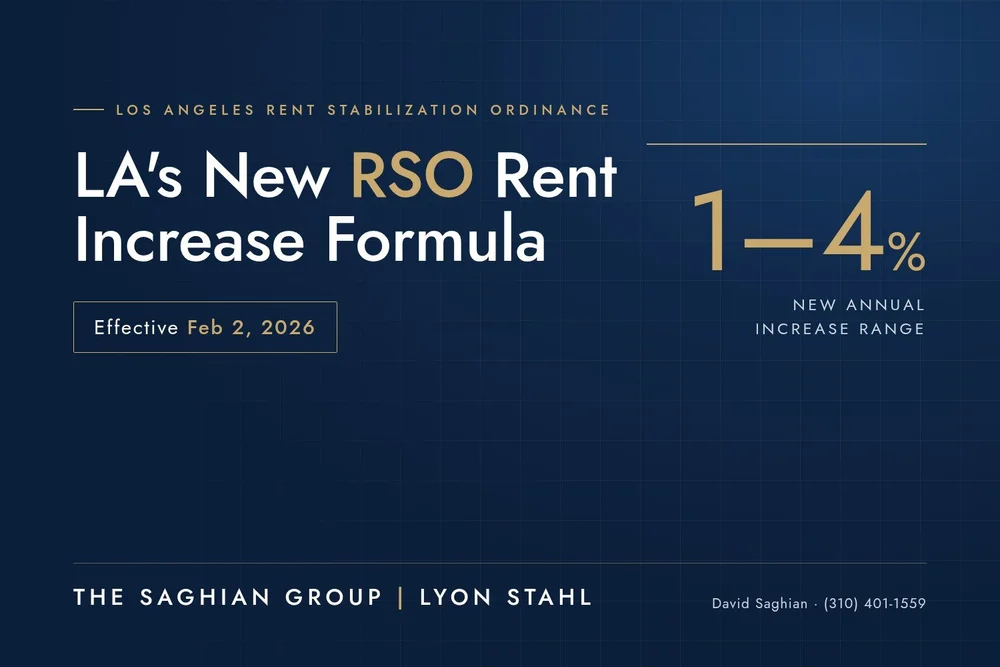
LA's new RSO rent increase formula took effect February 2, 2026.
Quick answer: Starting February 2, 2026, the City of Los Angeles calculates the annual Rent Stabilization Ordinance (RSO) increase at 90% of the local CPI change, with a 1% floor and a 4% ceiling. The old range was 3% to 8%. Annual increases can no longer include an extra percentage for landlord-paid utilities, and the 10% increase for adding a dependent to a tenancy is gone. The allowable increase for July 1, 2026 through June 30, 2027 is 3%, per the Los Angeles Housing Department (LAHD). For owners, the change lowers how much rents on long-term units can grow in high-inflation years, so buyers will lean even more on in-place rents and turnover when they price RSO buildings.
If you own an older apartment building in the City of Los Angeles, the rules for your annual rent increase changed this year. The City Council adopted Ordinance No. 188795 in December 2025, and it took effect on February 2, 2026. It rewrote the formula that sets the RSO increase each year and removed two add-ons owners have used for years.
None of this stops you from selling. RSO buildings still trade, and we have sold them. But it changes the math a buyer runs on your rent roll, so it is worth understanding before you set a price. This guide explains what changed, what it does to income and value, and how to prepare if you plan to sell.
What Changed in 2026
Here is the side-by-side, based on the ordinance and LAHD's summary:
| Item | Before Feb 2, 2026 | Starting Feb 2, 2026 |
|---|---|---|
| Annual increase formula | 100% of the average CPI change | 90% of the average CPI change |
| Floor | 3% | 1% |
| Ceiling | 8% | 4% |
| Extra increase for landlord-paid gas or electric | Allowed | Not allowed |
| 10% increase for an added dependent | Allowed | Not allowed |
| 10% increase for an added tenant who is not a dependent | Allowed | Still allowed |
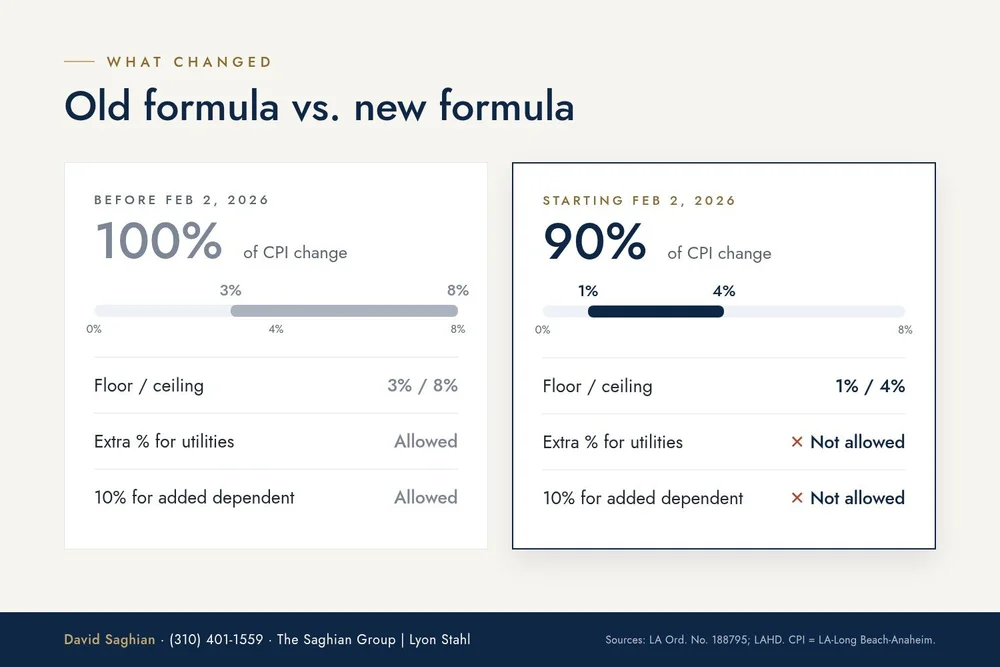
Old vs. new RSO formula. Sources: Ordinance No. 188795 and LAHD.
A few details matter:
- How the number is set. The formula uses the Consumer Price Index for the Los Angeles-Long Beach-Anaheim area, comparing the average for the 12 months ending September 30 with the 12 months before that. LAHD publishes the result each year, and it applies from July 1 through June 30. You can still raise rent only once every 12 months under this provision (LAMC 151.06 D, as amended).
- Utilities. LAHD says annual increases can no longer include any added percentage for utilities. The Council confirmed that this applies to annual increases taking effect on or after February 2, 2026 in a follow-up ordinance, No. 188911, effective April 20, 2026.
- Added occupants. No increase is allowed when a dependent joins the tenancy. If an added tenant is not a dependent, LAHD says you may raise the rent (and the deposit) by 10% for that person, but you must give notice within 60 days of learning about the new tenant, and the rent must come back down when that tenant moves out (LAHD bulletin).
- Deposits. The security deposit can rise by the same percentage, at the same time, as the annual rent increase.
The full legislative record is in Council File 23-1134 on the City Clerk's site.
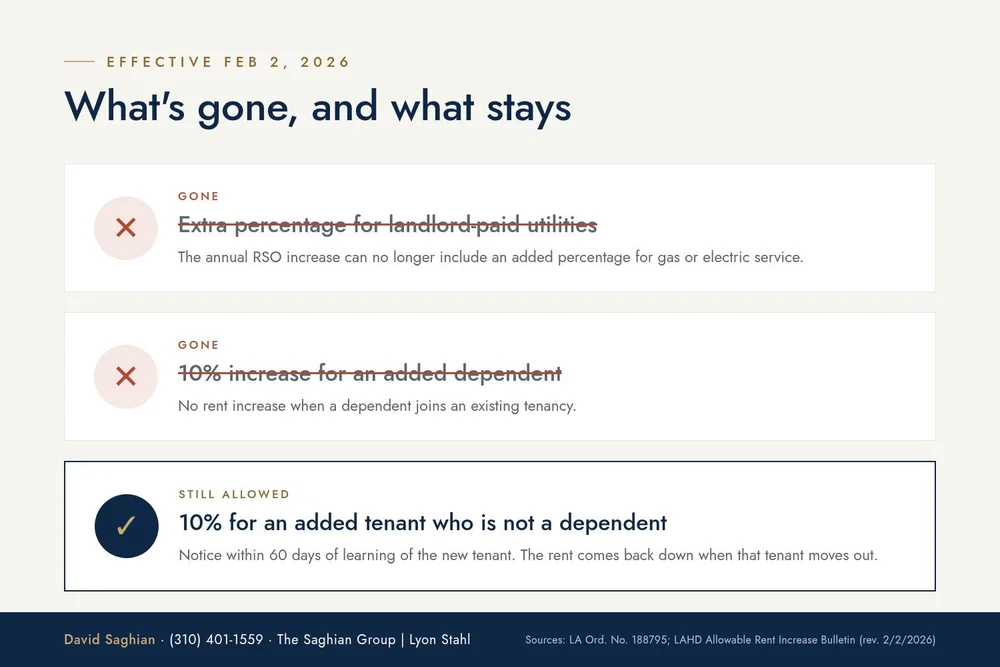
What the 2026 RSO changes removed, and the added-tenant increase that remains. Source: LAHD.
The Number for 2026–27: 3%
LAHD set the allowable RSO increase at 3% for July 1, 2026 through June 30, 2027. It was also 3% for July 1, 2025 through June 30, 2026, and 4% for the year before that, according to LAHD's history table.
The 3% for 2026–27 is inside the new 1%-to-4% range. What the new formula really changes is the outlook. In a year when local inflation runs high, the old rules allowed up to 8%. Now the most an owner can take in any year is 4%. In a low-inflation year, the old 3% floor is gone, and the minimum is now 1%.
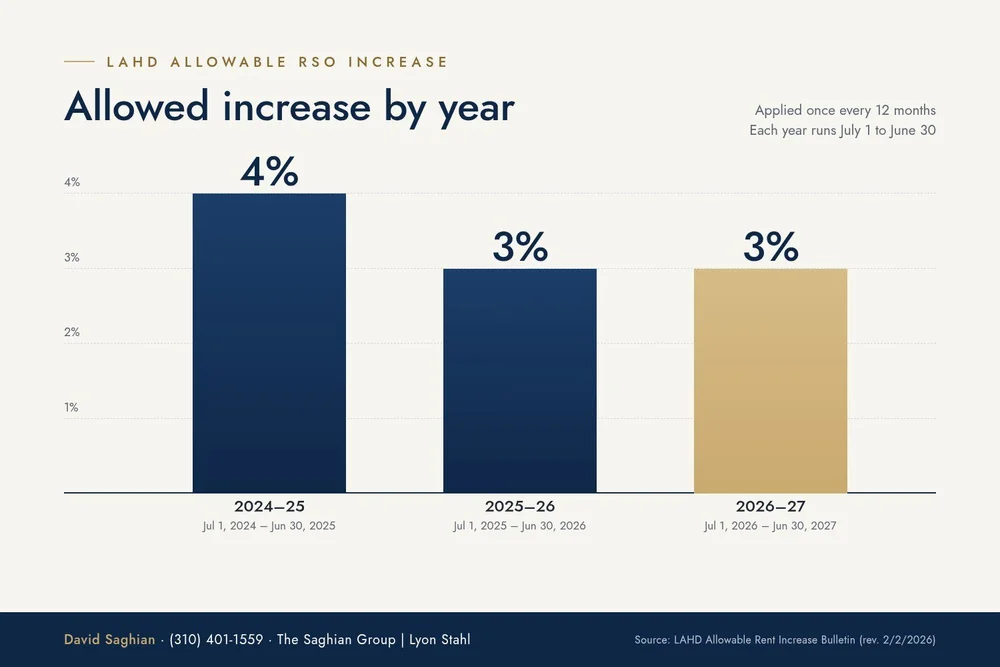
Allowable RSO increase by year, per LAHD. Each year runs July 1 to June 30.
Which Buildings Are Affected
The change applies only to units under the City of Los Angeles RSO. LAHD says the RSO generally covers rental properties first built on or before October 1, 1978, plus certain replacement units. Check the official status on ZIMAS under the Housing tab. The RSO is a city ordinance. Burbank, Glendale, Santa Monica, West Hollywood and Beverly Hills are separate cities with their own rules.
Newer buildings are usually outside the RSO. Our sale of 4727 Kester Ave in Sherman Oaks, built in 1984, was governed only by statewide AB 1482, so the RSO formula change does not touch a building like that. For how the two systems compare, see our guide to AB 1482 vs. LA rent control (RSO).
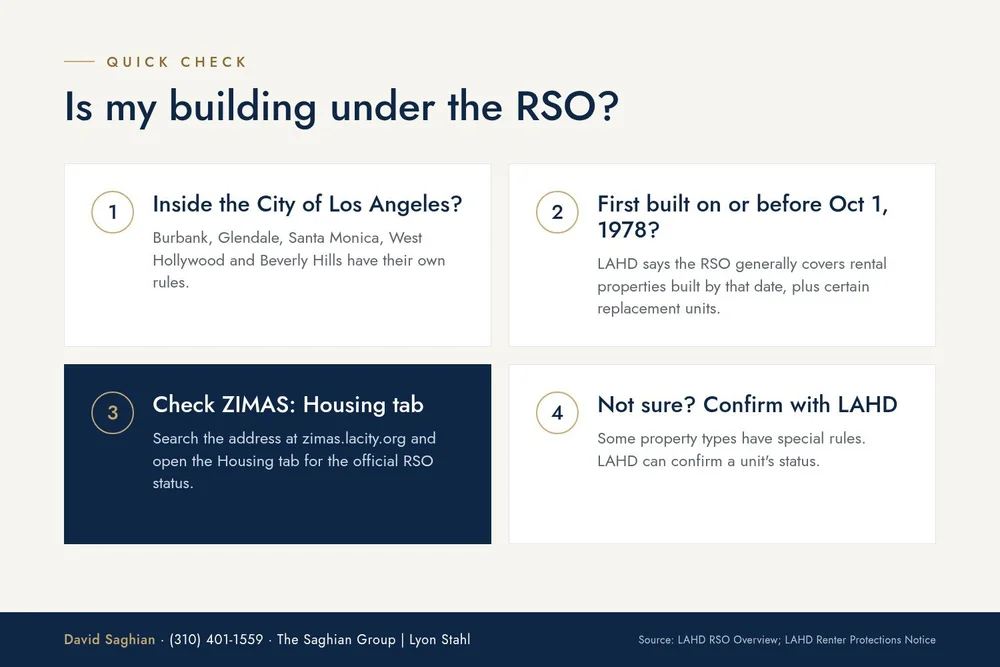
A quick check for RSO status. Source: LAHD.
What It Means for Your Income
For an RSO building, the change touches three income lines:
- Annual increases on long-term units. Your sitting tenants' rents can now grow by at most 4% a year, and as little as 1%. The higher the inflation, the wider the gap between what your costs do and what your rents can do.
- Utility recovery. If you pay tenants' gas or electricity, as many older master-metered buildings do, you can no longer add a percentage on top of the annual increase to help cover it. The utility bill keeps rising while that offset is gone.
- Added occupants. The dependent increase is gone, and the non-dependent increase is temporary by rule. A buyer should not treat it as permanent income.
Here is a simple, hypothetical example to show the scale. On a unit renting for $1,500 a month, a 4% ceiling means the most that rent can rise in a year is $60 a month. Under the old 8% ceiling it was $120. In a 3% year, the increase is $45 a month either way, but you can no longer add a utility percentage on top.
Metering is one of the first things buyers look at. Our sale of 20301 Cohasset Ave in Winnetka, a 22-unit building under LA City rent control, had all units separately metered for gas and electricity, and its closing page lists that as a strength. Compare a building like 18414 Collins St in Tarzana, a 1971 rent-controlled property that was master metered for both, which Tony Sameyah of our team listed and sold. On a master-metered RSO building, the utility change hits the expense side directly.
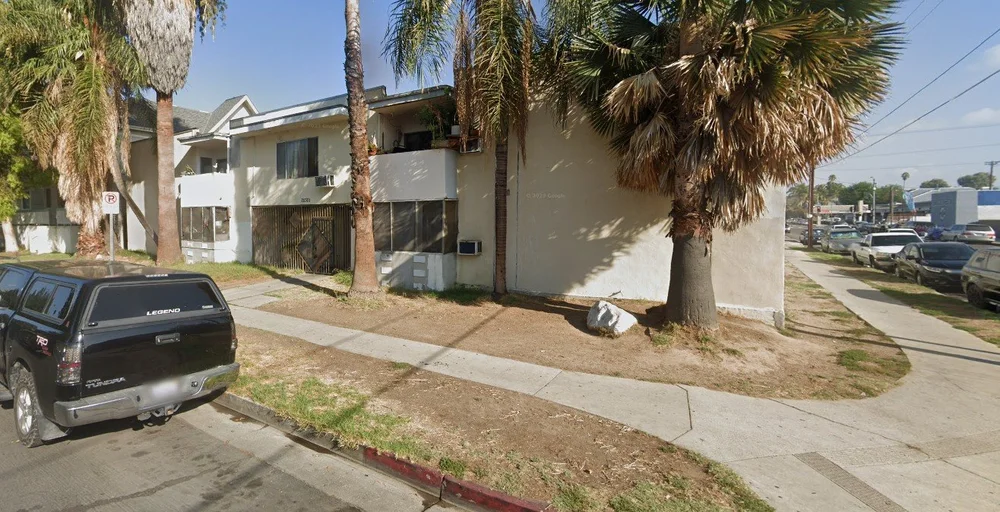
20301 Cohasset Avenue, Winnetka
What It Means for Value and Cap Rates
Buyers price apartment buildings on net operating income and on how they expect it to grow. The new formula lowers the ceiling on growth for units that do not turn over. Here is how that plays into a buyer's math:
- Lower assumed growth on in-place rents. A buyer modeling an RSO building can assume no more than 4% a year on occupied units, and many will model the low end. Slower expected income growth usually means a buyer pays less for the same current income, which shows up as a higher cap rate, or relies more on turnover to make the numbers work.
- More weight on the gap to market. Under the RSO, rent can generally reset to market after a lawful vacancy, such as when a tenant moves out voluntarily or accepts a properly filed buyout (LAHD). When annual increases are smaller, more of a building's upside sits in that gap. Buyers will look closely at each unit's rent, move-in date and turnover history.
- Expenses get more attention. Who pays utilities, how old the systems are, and what they cost to run all matter more when rent growth is capped lower.
- LAHD-approved increases still exist. The RSO still allows certain increases with LAHD approval, including capital improvement, primary renovation, seismic retrofit, rehabilitation and just-and-reasonable applications (LAHD bulletin). These follow their own rules and are not automatic.
How much any single building's value moves depends on its location, rents, metering, condition and turnover. There is no single market-wide figure for the effect yet, so compare closed sales of similar buildings from after the change. Our 2026 Los Angeles cap rate guide shows the cap rates on our own closings by neighborhood.
How It Affects Selling
Rent control does not stop a sale, but it raises the bar on your records. When a buyer underwrites an RSO building in 2026, expect these questions:
- Is every rent legal? Buyers and their lenders will check that each increase since February 2, 2026 followed the new rules: no utility add-on, no dependent increase, no more than once in 12 months and served with proper notice. LAHD says increases under 10% need 30 days' written notice, and increases over 10% in a 12-month period need 90 days. An increase that did not follow the rules is a problem to fix before you list, not during escrow.
- Which rents are temporary? If any unit carries a 10% added-tenant increase, flag it. It comes off when that tenant leaves.
- Who pays utilities? Have the utility bills and metering details ready, especially for master-metered buildings.
- Is the building registered? Current LAHD registration for every RSO unit is a standard request.
Clean records do not change the law, but they protect your price. A buyer who finds a problem in escrow will price it in. For the full sale process on an RSO building, read Selling a Rent-Controlled (RSO) Apartment Building in Los Angeles. If you are weighing timing, how long an LA apartment sale takes walks through each phase.
Owner Checklist for the New RSO Formula
- Confirm RSO status for each parcel on ZIMAS (Housing tab).
- Pull every rent increase notice served since February 2, 2026 and confirm none includes a utility percentage or a dependent increase.
- Confirm no unit was increased more than once in 12 months.
- List any units with a 10% added-tenant increase, with the date it started.
- Note which utilities you pay and whether the building is master metered or separately metered.
- Update your rent roll with move-in dates, current rent, last increase date and amount.
- Confirm LAHD registration is current for every RSO unit.
- Re-run your income projection at the 1% to 4% range, not the old 3% to 8%.
- Get a current valuation based on closed sales of similar buildings since the change.
The Bottom Line
LA's new RSO formula caps annual increases on long-term units at 4%, drops the floor to 1% and removes the utility and dependent add-ons. The 2026–27 increase is 3%. For owners, that means slower possible growth on in-place rents, and for buyers it means more attention on the gap to market, metering and clean records. If you are thinking about selling, know where your building stands before a buyer does.
To talk through how the change affects your building's value, call David Saghian at (310) 401-1559 or request a free property valuation.
This article is general information, not legal or tax advice. RSO rules change, and LAHD's bulletins and the Los Angeles Municipal Code control. Confirm your situation with LAHD or a landlord-tenant attorney before serving any notice. Last reviewed November 15, 2026.
Frequently Asked Questions
What is the new RSO rent increase formula in Los Angeles?
Starting February 2, 2026, the RSO annual increase is 90% of the change in the average Consumer Price Index for the Los Angeles-Long Beach-Anaheim area, rounded to the nearest whole percent. It cannot be lower than 1% or higher than 4%. Under the old rules, the range was 3% to 8%.
What is the RSO rent increase for July 2026 to June 2027?
LAHD set the RSO allowable increase at 3% for July 1, 2026 through June 30, 2027. It can be applied once every 12 months.
Can I still add 1% for gas and electric on an RSO unit?
No. LAHD says that, starting February 2, 2026, the RSO annual rent increase cannot include any added percentage for utilities. The Council confirmed this applies to annual increases taking effect on or after that date.
Can I raise the rent when a new tenant moves in with an RSO tenant?
If the added person is a dependent, no increase is allowed starting February 2, 2026. If the added tenant is not a dependent, LAHD says the rent and deposit may go up 10% for that person, with notice within 60 days of learning about them, and the rent must come back down when that tenant moves out.
Which buildings does the new RSO formula apply to?
Units under the City of Los Angeles Rent Stabilization Ordinance. LAHD says the RSO generally covers rental properties first built on or before October 1, 1978. Check the Housing tab on ZIMAS for the official status. Separate cities such as Burbank, Glendale, Santa Monica, West Hollywood and Beverly Hills have their own rules.
Does the new RSO formula lower my building's value?
It lowers the most that rents on long-term units can grow in a year, from 8% to 4%, and removes the utility add-on. Buyers price on income and expected growth, so slower growth usually means more weight on in-place rents, the gap to market and expenses. The effect on any one building depends on its rents, metering, condition and turnover, so compare recent closed sales of similar buildings.
Can rent go to market when an RSO tenant moves out?
Generally yes. LAHD says rent can be set at any amount on re-rental after certain vacancies, such as when a tenant moves out voluntarily or after a properly filed buyout agreement. Other vacancies, such as owner-occupancy evictions, do not allow a reset.
How do I reach David Saghian?
Call (310) 401-1559 or request a free property valuation on lamultifamilyadvisory.com. David Saghian is licensed with Lyon Stahl Investment Real Estate, DRE 01992252.